Showing posts with label Astronomy. Show all posts

Monday, January 06, 2014

2013: Year in review - My favorite movie

The next few posts will discuss some of the things that caught my attention (mostly positive, some negative) in the year gone by.  I am leading off with my favorite movie of the year.

These were the top-10 grossing movies in Hollywood:
1. Iron Man 3
2. Despicable Me 2
3. The Hunger Games: Catching Fire
4. Fast & Furious 6
5. The Hobbit: The Desolation of Smaug
6. Monsters University
7. Man of Steel
8. Gravity
9. Frozen
10. Thor: The Dark World

Of the top 10, I saw 6.  Not a bad ratio for me.  The ones I missed were Despicable Me 2 (since I have not seen the first one), The Hobbit (No interest whatsoever after the ponderous Lord of the Rings trilogy left me cold, Monsters University (liked the original too much to ruin the memories), and Frozen (I am a Pixar snob, what can I say?  Though I may well end up watching this one.  (I will revisit the Top 10 in a separate post with some pet peeves and concerns).

Among the Bollywood releases, I liked Kai Po Che!, Yeh Jawaani Hai Deewani (not the ending, though, as it reinforced stereotypes that I think it is time Hindi movies got away from), Bhaag Milkha Bhaag (even though it was too heavy-handed and syrupy), and Dhoom 3 (more on this and Krrish 3 in the afore-mentioned separate post).

But, by far, my favorite movie of the year was one that featured just two actors, one of whom is there for only about a third of the screentime.  Strap your seat belts and watch this extended preview first:


Some movies are meant to be seen on the big screen.  This one definitely was. Wow.  The movie combined my love of astronomy/outer-space with my fear of being adrift with no one but myself to pull off a rescue.  Sandra Bullock and George Cloony give Gravity the right amount of heft and their persona is so likable you start rooting for them within minutes.

If the movie is running in a nearby theater, go see it.  Don't worry about the 3D. The movie is a combination of an edge-of-the-seat thriller, how-dun-it with some spectacular visual effects and perfect acting.

I could tell you more but that would only spoil the fun.

Saturday, October 15, 2011

Fly over

I want to get off this planet and travel among the galaxies.  I wish I could jaunte like Gully Foyle.  Oh, how I wish the space program would take off and I could read books while a spacecraft slowly took me to my destination, the stars beyond the stars.

Until then, I will have to vicariously live my dream through the eyes of the astronauts at the International Space Station.


A time-lapse taken from the front of the International Space Station as it orbits our planet at night. This movie begins over the Pacific Ocean and continues over North and South America before entering daylight near Antarctica. Visible cities, countries and landmarks include (in order) Vancouver Island, Victoria, Vancouver, Seattle, Portland, San Francisco, Los Angeles. Phoenix. Multiple cities in Texas, New Mexico and Mexico. Mexico City, the Gulf of Mexico, the Yucatan Peninsula, El Salvador, Lightning in the Pacific Ocean, Guatemala, Panama, Columbia, Ecuador, Peru, Chile, Lake Titicaca, and the Amazon. Also visible is the earths ionosphere (thin yellow line), a satellite (55sec) and the stars of our galaxy. 

Wednesday, October 12, 2011

The eye of the beholder

The NASA website publishes one new photo everyday.  Most are usually spectacular.  Sometimes, they exceed even themselves.  Here's one such gem.  Click on the link to find out more.

Image credit: Cassini Imaging Team, SSI, JPL, ESA, NASA - September 2011
Look closely to the top left quadrant of the photo.  Inside one of the rings is a tiny blue dot - the Earth!

Monday, May 16, 2011

What if...

a) This is just mesmerizing....what would some of the planets look like in the night sky if they were the same distance from the earth as the moon?


b) What if the Earth had rings, just like Saturn does? How would it look from different cities across the world? How I wish this were true...*sigh*


c) And finally, if you have ever wondered what Hyderabad would look like if covered by snow, wonder no further. Here it is, courtesy some very imaginative CGI (from about the 1:35 mark).

Monday, April 18, 2011

A joy forever

This is the most beautiful video I have ever seen (The text provided below the video is by Terje Sorgjerd):

The Mountain from Terje Sorgjerd on Vimeo.

This was filmed between 4th and 11th April 2011. I had the pleasure of visiting El Teide.

Spain´s highest mountain @(3715m) is one of the best places in the world to photograph the stars and is also the location of Teide Observatories, considered to be one of the world´s best observatories.

The goal was to capture the beautiful Milky Way galaxy along with one of the most amazing mountains I know El Teide. I have to say this was one of the most exhausting trips I have done. There was a lot of hiking at high altitudes and probably less than 10 hours of sleep in total for the whole week. Having been here 10-11 times before I had a long list of must-see locations I wanted to capture for this movie, but I am still not 100% used to carrying around so much gear required for time-lapse movies.

A large sandstorm hit the Sahara Desert on the 9th April (http://bit.ly/g3tsDW) and at approx 3am in the night the sandstorm hit me, making it nearly impossible to see the sky with my own eyes.

Interestingly enough my camera was set for a 5 hour sequence of the milky way during this time and I was sure my whole scene was ruined. To my surprise, my camera had managed to capture the sandstorm which was backlit by Grand Canary Island making it look like golden clouds. The Milky Way was shining through the clouds, making the stars sparkle in an interesting way. So if you ever wondered how the Milky Way would look through a Sahara sandstorm, look at 00:32.

Like my Facebook Page for updates http://www.facebook.com/TSOPhotography

Follow me on http://twitter.com/TSOPhotography

Press/licensing/projects contact: terjes@gmail.com

Music by my friend: Ludovico Einaudi - "Nuvole bianche" with permission.

Wednesday, February 10, 2010

Like a planet scorned

A few years ago, Pluto was kicked out of the big boys club and downgraded to the status of a dwarf planet.

Astronomers around the world beware - Pluto is starting to get a little angry!
Pluto is turning brighter and redder as its 248-year-long rotation around the sun changes its seasons, NASA reported on Thursday.
(Credit: NASA, ESA, and M. Buie (Southwest Research Institute))

Friday, July 24, 2009

An eclipse to remember


On July 22nd, 2009, most of Asia got to witness the longest solar eclipse of the 21st century. Boston.com has a fabulous photo-spread of the event as it transpired in various locations.

For once, the pictures do tell the whole tale.

Man! On the Moon!! Now!!!

How would the media cover the moon landing today, 40 years after it was sedately (and awe-inducingly) delivered to the masses? If Walter Cronkite had seen this video, he probably would have realized that his time, indeed, was up. From anchorman to anachronism, such would have been his fate.


And this is how it layed out 40 years ago. (Note that the following video is the last part of a series of videos that you can see on Youtube.)

Sunday, January 07, 2007

Living on in infamy

As if being knocked out of the big planets club was not enough, Pluto has now given birth to a word with negative connotations, too! Being "word of the year" is some consolation, I guess.

Thursday, December 07, 2006

No mas

Until the 15th of December I shall not have any more cricket-related blog items. My non-cricketing friends are seriously considering boycotting this space if I persist.

So there, here's the first non-cricket entry:

Will they find the remains of the Ancient Mariner nearby, too?

Thursday, September 21, 2006

Elimination by alteration of definition

It appears that it is not just human beings who are being targeted for downsizing. Hard-working bodies of aggregated matter are being relegated to secondary status, too.

As most of you are probably aware of by now, instead of increasing the number of planets in our solar system as I had written about in an earlier blog entry, the total number has been reduced to 8, with Pluto ending its 76 year run with the big boys this year.

But the decision is not set in stone, as only a small proportion of astronomers actually voted on it. Pluto has its followers and they do not intend to go down without a fight.

So don't rewrite your high school astronomy notes just yet. As far as I know, Pluto is still merrily spinning away in the outer reaches of the solar system, oblivious to all the discussion ocurring on a planet far, far away.

Friday, August 18, 2006

And then there were 12

When humans set their mind to it, they can do almost anything. For decades we have been informed that there are 9 planets in our solar system, with Pluto occupying a very special place, inspite of its highly elliptical and off-plane orbit. But if you thought it was set in stone, you were dead wrong. With one meeting of many minds, the International Astronomical Union's specially appointed Planet Definition Committee has decreed that the definition of a planet needs to be revised. Actually, it appears that a planet has never been properly (scientifically) defined and the PDC has put together a proper definition. This definition is also just as arbitrary, but who are we to comment on this? Anyway, this is the gist of the new definition:
(A planet is ) an object...massive enough that gravity has formed it into a sphere and that it circles a star and not some other planet.
With that one decision we now have 12 planets in our solar system. I wouldn't rush to re-write the astronomy books, if I were you. I doubt that this change will be accepted without a little bit of discussion and a vote scheduled for August 24th. In the end, honestly, who cares if we have 9 or 12 planets, except for astronomers and astrologers, of which I am neither.

Thursday, July 27, 2006

The Warrior Princess and her sidekick

Not satisfied with announcing that the discovery of a tenth planet in the solar system, astronomers led by Michael Brown of the California Institute of Technology have found that it even has a moon circling it. Since the planet has been named Xena the moon has, but of course, been named Gabrielle.

But whether Xena remains a planet and Gabrielle her faithful moon remains to be resolved. We shall know in a few months from now when the International Astronomical Union (yes, such an organization does exist) will decide upon this matter. Until then the definiton of a planet shall be up in the air, pardon the pun.

Saturday, November 12, 2005

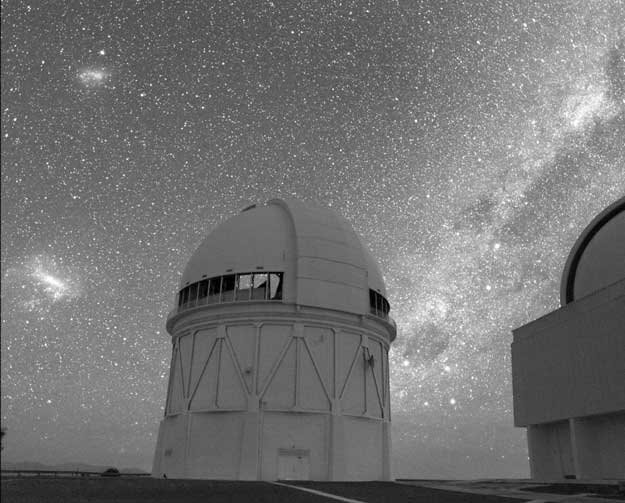
Night vision

The dust- and pollution-free atmosphere of the lower southern hemisphere allows photographers to capture the Milky Way and other galaxies very clearly at night. The above photo, amazingly, was shot without any additional or artificial light. Imagine lying on the ground at night and looking up at that. No wonder the great poets of the past rhapsodized endlessly about stars in the sky.