(Monday PM: See update after the video)
Andre Agassi has been in the news a lot lately, mostly for the soul-searching autobiography he wrote. Over the past few months even as he lost some fans he made many, many more with the candor in his book and the honesty with which he talked about his own foibles.
A couple of days ago he got into a spat with Pete Sampras at an exhibition event. The genesis of the disagreement lies in his admission in Open the Sampras is a lousy tipper. The mood just got a little uncomfortable after that for not just the two of them but also the other fellows on the court (Federer and Nadal) and the crowd.
Showing posts with label Andre Agassi. Show all posts
Showing posts with label Andre Agassi. Show all posts
Monday, March 15, 2010

Saturday, January 02, 2010
Open and shut

a) First up, Prem Panicker (formerly of Rediff, now at Yahoo India) reaches back into his own past and finds parallels with Agassi.
And the players: a constant, dazzling parade on the other side of the net of some of the greatest names of the age. What we often tend to lose sight of is that in a career that spans 1986-2006, Agassi has storied players fade and fresh talent emerge. He has battled McEnroe, Lendl, Edberg, Connors and Becker [the latter two he treats with undisguised contempt]; he has seen the likes of Courier and Wilander emerge, soar and ebb; he has seen the metamorphosis of Pete Sampras from a ‘no talent’ tyro to his arch-nemesis [“I wish I could emulate his spectacular lack of inspiration, and his peculiar lack of need for inspiration,” Agassi says in one of the many cathartic moments in the book]; he has played against and outlasted the greatest names of two decades and, in his twilight years, seen the emergence of Roger Federer, the player who he names, against the backdrop of their first meeting, as the one destined to be the greatest ever.
Those names, and Agassi’s photographic memory for match detail, drive large sections of the book and provide unmatched insight into what goes on in the mind of a player as he battles back from the edge.
But it is his personal journey – from traumatized boy to troubled teen; from precocious talent to chronic under-achiever; from the ‘Image is Everything’ parody to the dignified champion who, in his last hurrah at the 2006 US Open, made fans weep the bitter tears of personal loss – that gives the book its cutting edge.
 b) Agassi and Steffi Graf talked to Rebecca Johnson of Vogue about their love for each other and their life together.
Open expertly captures the profoundly stressful job of professional tennis player, but nobody who hasn’t lived it can ever truly understand what it does to a person’s psyche. “I am surprised when people ask me about the ‘glamorous’ tennis life,” Graf says, “because it is really a demanding sport. You’re traveling twelve months a year, with no off-season. You have a coach and maybe a parent traveling with you, but there is limited opportunity for friends. It never stops. It’s not cruel”—Graf hesitates, searching for the right word—“but it’s excruciating.” Agassi agrees. “Emotionally, physically, mentally, it is so demanding. ‘Rest’ is the real example of what a grind it is. When you’re not playing, you have to just sit there and do nothing. You can’t go out in the sun; you can’t go out and do anything, because you are in training. I used to think I was moody, but then, after I retired, I realized, I’m not moody. It’s tennis that’s moody.”c) The New York Times' review by Sam Tanenhaus is more along the same lines.
The result is not just a first-rate sports memoir but a genuine bildungsroman, darkly funny yet also anguished and soulful. It confirms what Agassi’s admirers sensed from the outset, that this showboat, with his garish costumes and presumed fatuity, was not clamoring for attention but rather conducting a struggle to wrest some semblance of selfhood from the sport that threatened to devour him.d) The Globe and Mail recruited Alex Pugsley to review the book. The review gives a good glimpse into the narrative of the book itself but not much more than that.
So after 30 years, after 1,000 matches, eight slams, 60 titles and an Olympic gold metal, the contradictions come full circle. The kid who dropped out of school at 14 now operates a charter school for hundreds of at-risk children in Las Vegas. Earlier this year, the institution celebrated its first graduating class. Regardless of underpants and wigs and failed drug tests, that's an exceptional achievement – and a capping legacy for one of America's quintessential celebrity athletes.e) Michael Mewshaw, for the Washington Post, references the mafia and Charles Dickens in a well-written piece.
While not without excitement, Agassi's comeback to No. 1 is less uplifting than his sheer survival, his emotional resilience and his good humor in the face of the luckless cards he was often dealt. In the end he made some inspired choices, not simply by marrying Steffi Graf, starting a charitable foundation for the education of poor children and finding a terrific ghostwriter in J.R. Moehringer, a Pulitzer Prize winner, but also by refusing to put pressure on his kids to play tennis.f) Jay Mariotti takes the issue of Agassi's admission of crystal meth usage as the central point of the review and admires him for his candor.
When a sports celebrity writes a book, it's too often filled with self-serving pap intended to enhance an image. Agassi's book brought him down, something I've rarely seen in sports publishing. He wants us to feel compassion for his previous troubles, which seems a fair request. Substance abuse is not cheating in the same vein as steroids use. Early in his career, he was a young man finding his way through depression and stardom. His story sounds familiar to that of Jennifer Capriati, who rose to prominence in his early teens before turning to drugs. During her rousing comeback, we cheered for her. Didn't Agassi follow a similar career path? I suppose we could criticize him for not coming out earlier, when he was still active as a player and wasn't selling a book. But that's what memoirs are -- telling the truth, the whole truth and nothing but the truth. "If you're going to tell your story, you owe it to yourself to tell it honestly," Agassi said.g) Of course, it would be remiss of me if I did not link to a review that absolutely slams the book. Janet Maslin of the New York Times painfully recounts all the (to her) cringe-inducing moments in the book. I guess not everyone was "taken in" by Agassi's early assertion that this was a chronological representation of his world from his point of view.
"Especially if you're going to call it 'Open.' ''
Welcome to Mr. Agassi’s world. As described in “Open” it is lively but narrow, since Mr. Agassi’s curiosity does not extend far beyond tennis, more tennis, the misery of tennis, the way sportswriters misunderstand tennis and the irritating celebrity that tennis stardom confers. The biggest extracurricular events in Mr. Agassi’s life have been prompted by episodes of “60 Minutes” (one of which inspired him to open a charter school for at-risk children) and by friends’ predictions about which women he would meet, court and marry.

(Longines 2009)
Tuesday, December 22, 2009
A mirror turned inwards
 In the late 1980's when my sporting world was crying out for someone to root for, along came Andre Agassi. Ivan Lendl was (and still is) my favorite tennis player ever, but I knew that his days at the top were close to being done, especially after the gut-wrenching twin Wimbledon finals losses in '87 and '88. I liked Andre Agassi for his game and not his looks or fashion sense. I was ambivalent about all that extraneous stuff. To each his own and all that jazz.
As the years rolled on I watched Chang, Sampras, and Courier (in that order) win Grand Slams while Agassi came close but never sealed the deal. I despaired for the fellow, feeling that it was my fate in life to root for almost-can causes. And then 1992 happened. After shunning Wimbledon for years, Agassi finally chucked his flamboyant, fluorescent gear for some whites and acquited himself quite well in 1991. The following year he came through and won it all beating Goran Ivanisevic and his (then) Wimbledon record 37 aces in the final (208 for the tournament). Agassi had broken through and, incredibly, it was on the least-expected of surfaces - grass. He had done what Lendl could never do.
It was at the press conference afterwards that he said something that changed the way I perceived top athletes and what drives them. A reporter asked him if he was as surprised as most other people were at winning Wimbledon. Agassi deadpanned, "I am not surprised that I won. Why would I play a tournament if I did not think I could win it?" Conditioned as I was to years of hearing about how it was the path that was important and not the winning, it served as a jolt to my senses. Since that day I have never been satisfied with moral victories on the playing field. If you don't play to win, you don't play to the best of your abilities. No matter how overmatched I am, I have not lost till the final scoreline is set or the final wicket has fallen.
As the years went by Agassi went through a series of ups and downs (more downs than ups) and re-emerged in 1999 in his latest avatar - a suave, articulate, and sage senior citizen - quietly putting together a stirring bookend to his career, cementing his place in the pantheon of tennis greats. The punctuation on his life was set when he and Steffi Graf settled down together.
Which brings me to Andre Agassi's autobiography, titled Open. The book is exactly that - an open examination of his life and his times from his point of view. Starting from the time he was a young kid to the present day, Agassi takes us with him on a journey of self-discovery and awareness. Co-written with JR Moehringer, the narrative style is in the present tense and is meant as more than an effect. Agassi tells us what he was thinking at that point in time about the events unfolding around and to him. This has led to some wildly misinterpreted outpourings in the media as writers have taken his words as a representation of his current way of thinking. More on that a bit later.**
Open is a shockingly vivid and honest examination of Agassi by himself. Like all of us, he tells things as he perceives them but he is honest enough to admit that. So, if your memory of events differs from his, there is nothing wrong with that. Do you see what I mean?
At last I let my mind go where it's wanted to go. I can't stop it anymore. No longer asking politely, my mind is now forcibly spinning me into the past. And because my mind notes and records the slightest details, I see everything with bright, startling clarity, every setback, victory, rivalry, tantrum, paycheck, girlfriend, betrayal, reporter, wife, child, outfit, fan letter, grudge match, and crying jag. As if a second TV above me were showing highlights from the last twenty-nine years, it all flies past in a high-def whirl.There are numerous revelations, most of them highlighted over the past few weeks by the media, but I am not here to list them or belabor the importance of those statements. Instead what I want to talk about are the two persons he admires above all - his trainer Gil Reyes and his wife Stefanie Graf (Steffi, he informs us, was a name picked by the German press and she does not like being called that!).
Andre's father was a man possessed with the thought of ensuring that one (or more) of his children lived his dream for him. Andre was lucky that he had a gift - to be able to spot a moving ball better than most mortals - that enabled him to survive the harshness of his father's training sessions. Not everyone can be so lucky. I sincerely believe that one of Agassi's main intentions with this book is to show people that even (superficially) successful people like him have had troubling pasts and to overcome them is hard but it can be done. In Gil Reyes, Agassi found the elder brother/father that he sought. No man engenders more respect from Agassi than Gil does in this book. Agassi-Graf named their first child Jaden Gil in honor of Gil and one of the tenderest moments in the book is when Agassi describes the moment when he told Gil about this.
For a long, long time Agassi admired Graf from afar. The icy Graf does not hate or dislike Agassi. No, in the worst scenario possible for him, she is indifferent about him. Open begins by talking about Agassi and his hatred of tennis but, along the way, transforms into the love story of Agassi and Graf. Even as Agassi's views on tennis and the world change, so does the reader get pulled into this aspect of his life.
Agassi never had a formal education beyond the 7th or 8th grade and he openly acknowledges that tennis gave him the security that most other people with his level of education lack. Therefore, his driving passion these days is his school for underprivileged children set in the middle of Las Vegas' worst neighborhood - the Andre Agassi College Preparatory Academy. Agassi's labor of love is the focal point of the last chapters of the autobiography and, by then, a more crystallized view of the man emerges. The book ends with a fairytale-ish finish but that highlights a very important change in the man - he does love tennis, after all.
**(Note: Since the book is written in the present tense, Agassi tells us what he is thinking about persons or events as they occur. Like all of us, his opinions change over time, and that is reflected in the book, too. Unfortunately for him, many writers picked up on the subtext from particular times and drew erroneous conclusions from it. Agassi did think that Pete Sampras would never make it in tennis. He did think that Sampras had other defects. But in time, Agassi changes his opinion of the only man who truly outclassed Agassi on the tennis court when he was in his prime. Agassi and Sampras are acknowledged to have had one of the best rivalries in tennis history, but hearing from Agassi you find out that after the initial years he never was Sampras' equal. Any wins he had against Sampras were against the grain as opposed to some deciphering of the Sampras code.
Our rivarly has been one of the lodestars of my career. Losing to Pete has caused me enormous pain, but in the long run it's also made me more resilient. If I'd beaten Pete more often, or if he had come along in a different generation, I'd have a better record, and I might go down as a better player, but I'd be less.At the very end of Agassi's career he acknowledges that he has run into an opponent far more formidable than Sampras, a player he feels is "well on his way to being the best ever" - Roger Federer. Talking about the 2004 US Open final loss to Federer, Agassi says:
... he (Federer) goes to a place that I don't recognize. He finds a gear that other players simply don't have. He wins 7-1....We were dead even. Now, due to a tiebreak that made my jaw drop with admiration, the rout is on.
Walking to the net, I'm certain that I've lost to the better man, the Everest of the next generation. I pity the young players who will have to contend with him. I feel for the man who is fated to play Agassi to his Sampras. Though I don't mention Pete by name, I have him uppermost in my mind when I tell reporters: It's real simple. Most people have weaknesses. Federer has none.
Friday, November 13, 2009
Falling from the sky
Continuing on from my earlier thoughts about Andre Agassi's autobiography, here's a really nice interview with the man. A big chunk of it is spent discussing his relationship and love for Steffi Graf (Stefani or Stef to Andre).
(The interview is spread over multiple pages, so do read them all. Also, someone asked me why my earlier post was titled "Stuck in a date". I based it on a translation of, "आसमान से गिरा, खजूर में अटका.")
Agassi has been pilloried by many of his peers for his admissions of past indiscretions, and addresses the reason for writing the book here.
(All emphasis in bold are mine.)
(The interview is spread over multiple pages, so do read them all. Also, someone asked me why my earlier post was titled "Stuck in a date". I based it on a translation of, "आसमान से गिरा, खजूर में अटका.")
Agassi has been pilloried by many of his peers for his admissions of past indiscretions, and addresses the reason for writing the book here.
(All emphasis in bold are mine.)
SPIEGEL: Then why did you write this book?
Agassi: I felt like I had a lot of things to say. I felt that there are a lot of people who wake up in a life they didn't choose. There's a lot of grown-ups that are in a marriage they don't want to be in. There's a lot of teenagers trying hopelessly to understand themselves. And I felt a book could be a platform to give people hope, inspiration and the tools to better their life.
SPIEGEL: Isn't that a bit much? That sounds like a missionary's approach.
Agassi: Well, if I did not believe that people might learn a lot about me -- and maybe a lot about themselves -- through my story, I wouldn't have done it.
SPIEGEL: I guess you didn't need the money, did you?
Agassi: (laughs) I have a lot more to lose than to gain with what I've written. I put endorsements on the line, but also my reputation, my character -- or how it is perceived -- and some relationships.
(...)
Agassi: You've got one chance to tell your story; you've got to give it all you've got. It's like in sports or when you are pregnant or when you become a father: You have to commit without fearing failure. I had no idea where this would lead me. I knew the different stories of my life but not the meaning, not the story of it all. I had the pearls but no idea what the necklace would look like.
SPIEGEL: Books on sports are usually a lot like cheating: There are five or six interviews, and then a ghostwriter sits down and pens something nice -- and everybody makes money.
Agassi: Maybe, but I wanted something different. When I went into retirement three years ago, I was reading this book called "The Tender Bar" and rationing its pages because it was giving me an escape from a lot of the feelings I was going through. It was so powerful. I wondered if my life -- looked at through a literary lens -- could impact somebody the way this book impacted me. What would my life look like through a real deep analytical view of my psyche and my contradictions?
Monday, November 09, 2009
Stuck in a date
I have been a fan of Andre Agassi from the time he burst on the scene in the late 80's. My brother, who was touring the US during that time frame, brought back a Tennis magazines that featured Agassi and I was hooked. After Ivan Lendl retired, I needed a player to root for and I stuck with Agassi through thick and thin.
When I found out he was coming out with an autobiography, I was excited and pre-ordered it from Amazon that day itself.

To whet our appetites, an excerpt was released on Sports Illustrated (link here). Lost in the scandal about recreational drug use was the story of a kid who did a fantastic job of hiding his dislike for the game. It is compelling reading, but not without its critics.
Martina Navratilova is shocked at Agassi's admissions. Roger Federer and Rafael Nadal are not far behind in expressing their displeasure, too.
In India, Harsha Bhogle stepped onto a soapbox and used his column to slam Agassi for letting down his fans and that he had "spoilt the week" filled with other good news. His thesis is that pardoning Agassi would open the floodgate to impressionable fans choosing to go Agassi's route. I am not sure Harsha thought this through well enough. This article is not up to his normal standards. He starts off with a statement that is so absurd, it bears repeating here:
Rick Reilly (of ESPN.com) goes to the other extreme and lauds Agassi for his honesty.

When I found out he was coming out with an autobiography, I was excited and pre-ordered it from Amazon that day itself.

Martina Navratilova is shocked at Agassi's admissions. Roger Federer and Rafael Nadal are not far behind in expressing their displeasure, too.
In India, Harsha Bhogle stepped onto a soapbox and used his column to slam Agassi for letting down his fans and that he had "spoilt the week" filled with other good news. His thesis is that pardoning Agassi would open the floodgate to impressionable fans choosing to go Agassi's route. I am not sure Harsha thought this through well enough. This article is not up to his normal standards. He starts off with a statement that is so absurd, it bears repeating here:
Andre Agassi has just added a convenient truth to an earlier, convenient lie. In an attempt to come out smelling of roses, he does far too much damage to those who look up to him, and other sportsmen, as role models. At the best of times it’s a flawed equation, this assumption that a fine sportsman is a fine person, but it exists and I fear Agassi may have given people reason to indulge in drugs.What? Did he really write that? He, of all people, should know better than to gauge the contents of a book based on a few articles in the media. To quote Sherlock Holmes: "It is a capital mistake to theorize before you have all the evidence. It biases the judgment."
Rick Reilly (of ESPN.com) goes to the other extreme and lauds Agassi for his honesty.
Why is Agassi so scorchingly honest in these excerpts? Maybe because he once lived enough lies for five men. Or maybe because, as an educator, he's heard the truth can set him free.Finally, I will leave you with Prem Panicker, who addresses Harsha's article and provides a searchingly personal article in support of Agassi's decision.
But hopefully, by the time you close "Open," you'll know that this book is about more than the wrong turns he took. It's about how that broken road led him straight to the good man he is now.
I don’t mean to suggest that post facto honesty absolves Agassi of a ‘crime’ we would have known nothing about had he not chosen to speak to the record. He confessed, and now he can take whatever knocks come to him, and welcome.I shall read the book from cover to cover. For all his faults (and he appears to list so many of them) Agassi has been at the helm of many great causes, and the reason for many of my fond memories of tennis. I shall always hold him in high stead for that.
I do, however, intend to point out that in our obsession with the ‘scandalous’ coda to the story of a life lived on the edge [from which we single out for notice not the important bits, but such inanities], we are perhaps in danger of overlooking the intrinsic worth of this book. And that (...) would be a tragedy, because such openness is rare enough to be treasured.

(C.S. Manish 2007)
Tuesday, August 18, 2009
Beyond flash

Even as memories of his exploits on the field begin to diminish (in some sports fans minds), Andre Agassi's aura continues to increase due to all the charity work he does. It is no surprise that he will be honored at the opening ceremony of this year's US Open.
I like reading any news about a select few persons, and Agassi is high on that list. One of my life's biggest regrets is that he played his last match one round earlier than I had anticipated so I never got to see him play in person.
Wednesday, September 13, 2006
I bet you did not know..
I have followed Andre Agassi for years. When he retired, a long-forgotten nugget surfaced in my brain when people started talking about his career. It took me some time, and lots of digging around, but my memory did not fail me.
In his first tournament, Agassi lost to Mats Wilander, then ranked #3 in the world. However, in his very next tournament in Schenectady (New York), he reached the finals where he lost to the #33rd ranked player in the world.
The person who defeated Agassi in his very first tournament final was none other than Ramesh Krishnan! If you do not believe me, check out this link!
In his first tournament, Agassi lost to Mats Wilander, then ranked #3 in the world. However, in his very next tournament in Schenectady (New York), he reached the finals where he lost to the #33rd ranked player in the world.
The person who defeated Agassi in his very first tournament final was none other than Ramesh Krishnan! If you do not believe me, check out this link!
So long, farewell...
At the US Open, minutes after losing the final professional tennis match of his career, Andre Agassi spoke to the crowd. For a man who never completed high school, the guy is pretty articulate. Journalists around the world came to appreciate him because he responded with more than just the generic soundbyte when he was asked a question. In the wake of his retirement, many people wrote articles of the times when they crossed paths with Double A, one of the best ones I read was written by his former roommate.
Here is the full text of his final speech, which brought a lump to my throat, and a tear (or two) to my eye when I heard it during a highlights show.
Here is the full text of his final speech, which brought a lump to my throat, and a tear (or two) to my eye when I heard it during a highlights show.
The scoreboard said I lost today, but what the scoreboard doesn't say is what it is I have found. And over the last 21 years, I have found loyalty.
You have pulled for me on the court and also in life. I've found inspiration. You have willed me to succeed sometimes even in my lowest moments. And I've found generosity.
You have given me your shoulders to stand on to reach for my dreams, dreams I could have never reached without you. Over the last 21 years, I have found you. And I will take you and the memory of you with me for the rest of my life.
Thank you.
Agassi Unplugged
Gary Smith, of Sports Illustrated, recently wrote an in-depth, revealing article on Andre Agassi, touching upon the various forces that drove the man and, in turn, were driven by him.
It is a long article, at times rambling, but in the end it is a touching portrait of the man. A must-read, especially for those that want to know more about how he pursued and wooed one of the most dominating tennis players of all-time - Steffi Graf.
It is a long article, at times rambling, but in the end it is a touching portrait of the man. A must-read, especially for those that want to know more about how he pursued and wooed one of the most dominating tennis players of all-time - Steffi Graf.
Tuesday, September 12, 2006
The long goodbye
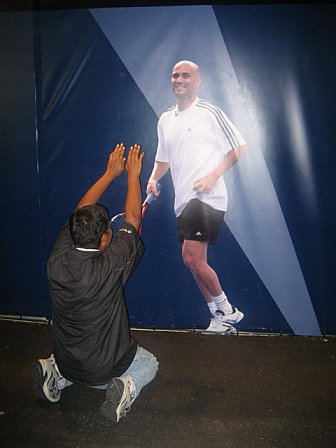
At Wimbledon this year Andre Agassi announced that he would retire from professional tennis at the US Open. Soon after I heard this I booked tickets to watch the US Open on September 4th, the second Monday of the tournament. If Agassi survived 3 rounds he would be playing a fourth-round match that day. Agassi survived just two but gave enough glimpses of his skills to keep his admirers happy and hopeful. In then end, his back could not hold up much longer and he lost to an unranked German named B Becker. It was an oddly fitting way for him to go.
I missed seeing him in person by a day, but that did not stop me from paying tribute when I came across a life-size photo of his!

I missed seeing him in person by a day, but that did not stop me from paying tribute when I came across a life-size photo of his!
Tuesday, August 08, 2006
So long and thank you
There are just a few weeks left in the professional tennis career of Andre Agassi. To honour the man and what he has meant to the sport, especially in the recent past, the official website of the ATP Tour pays a very generous tribute to him.
While on this, most news stations are reporting that Andre is retiring from tennis, which is an absurd statement to make. In reality he is retiring from his life as a professional tennis player. I sincerely doubt that he will never pick up a racquet again, as the reported term implies.
And yes, I have already purchased tickets to watch tennis at the Arthur Ashe Stadium on Monday, September 4th. I trust that Agassi survives the first week of the US Open. For if he does he is definitely going be the featured singles match that night and I hope to be able to tell my grandchildren about the experience some day.
While on this, most news stations are reporting that Andre is retiring from tennis, which is an absurd statement to make. In reality he is retiring from his life as a professional tennis player. I sincerely doubt that he will never pick up a racquet again, as the reported term implies.
And yes, I have already purchased tickets to watch tennis at the Arthur Ashe Stadium on Monday, September 4th. I trust that Agassi survives the first week of the US Open. For if he does he is definitely going be the featured singles match that night and I hope to be able to tell my grandchildren about the experience some day.
Saturday, June 24, 2006
Once more unto the breach
Andre Agassi, one of my favourite tennis players of all-time (Ivan Lendl is still numero uno, Stefan Edberg, Martina Navratilova and Leander Paes round up my top 5) is going to end his tennis career at the US Open this year.
The only man to have won all 4 Grand Slam events and an Olympic gold medal (incidentally his wife, Steffi Graf, is the only person on the distaff side to have done so) Andre has fought hard against the power-serving brigade for almost two decades and done it (for the most part) with grace and class. I will miss watching him very much when he retires.
I hope he has a couple of deep runs left in his legs at the two remaining Grand Slams.
The only man to have won all 4 Grand Slam events and an Olympic gold medal (incidentally his wife, Steffi Graf, is the only person on the distaff side to have done so) Andre has fought hard against the power-serving brigade for almost two decades and done it (for the most part) with grace and class. I will miss watching him very much when he retires.
I hope he has a couple of deep runs left in his legs at the two remaining Grand Slams.
Subscribe to:
Posts (Atom)